
Built by people
who've done the work.
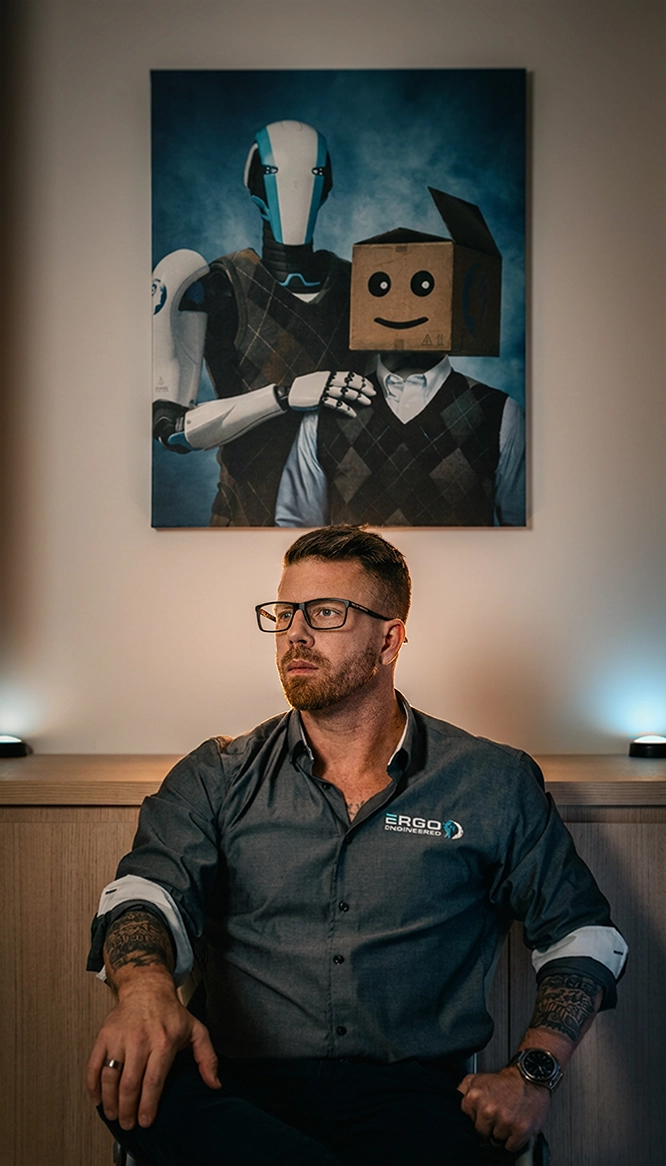
Founder-led by Nik Pearsall - Human Factors & Systems Engineer, and the one at the keyboard at 2am.
Nik Pearsall
Founder & Human Factors Lead
If you want the long version - the F/A-18s, the Master's degrees, the Boeing years, the patents - it's all on the Journey page. This isn't that. This is the team behind Ergonomics Engineered, and where I sit in it.
Short version of me: I'm the one who builds. Founder, Human Factors and Systems Engineer, and the person at the keyboard at 2am turning a methodology into a working tool. No investors steering the roadmap, no board to please - just the tools I wish I'd had, built by someone who's actually done the work.
But I don't build it alone - and the two droids aren't the only company I keep. Before you meet them, meet the person who makes sure what I build actually ships.
The full story Journey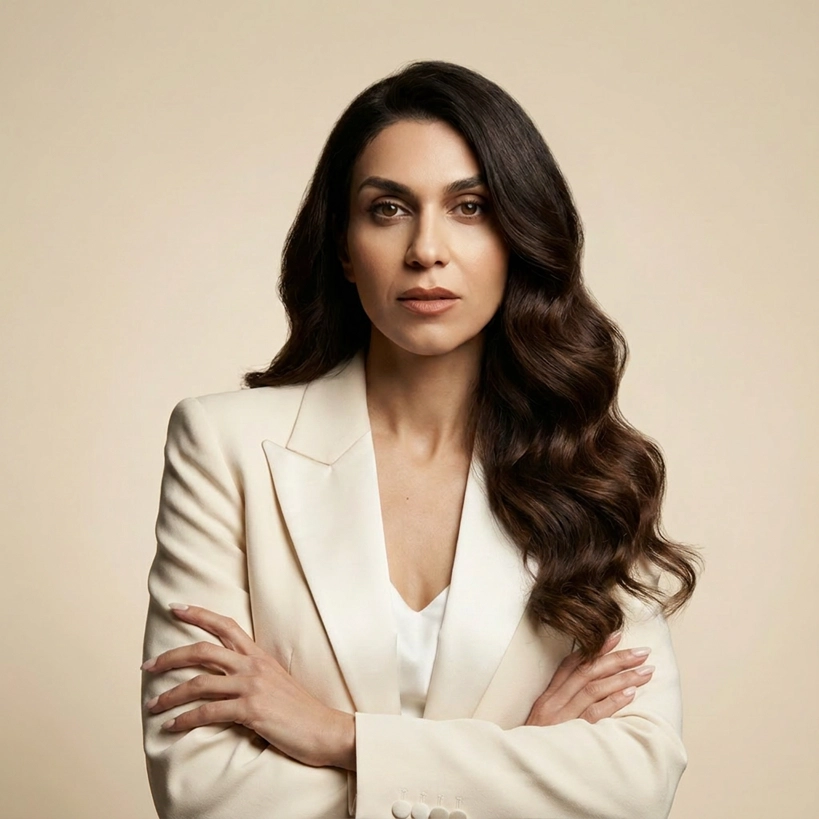
Parnia
Product & Program Manager
The reason things actually ship.
She came to Human Factors from architecture: a Bachelor of Architecture and a Master of Interior Architecture, where her research dug into how interior spaces affect people with autism and learning disabilities. That work matters more to what we do than it might first appear. Human Factors lives and dies on designing for the full spread of human variation - not the average user, but the edges, the people standard design quietly leaves behind. Parnia spent her Master's studying exactly those people. She thinks about fringe users by instinct, and that instinct runs through every product decision we make.
Then there's the delivery side. She holds a second Master's in Project Management and spent years in the construction industry as a Contract Administrator - the discipline of keeping complex, high-stakes programs on schedule, on scope, and accountable. In our world that isn't a soft skill; it's the difference between a clever idea and a finished product.
As Product & Program Manager, Parnia owns both: what we build and how it gets built. She keeps the roadmap honest and the timelines real, and she makes sure the human at the centre of our work is the whole human - not just the convenient one.
And then there are the two droids.
Harry & Charlie
The droids you have been looking for
Yes, the company has two droid mascots. No, it's not a gimmick a marketing agency sold me - this is self-funded too, and there's a real story behind both of them.
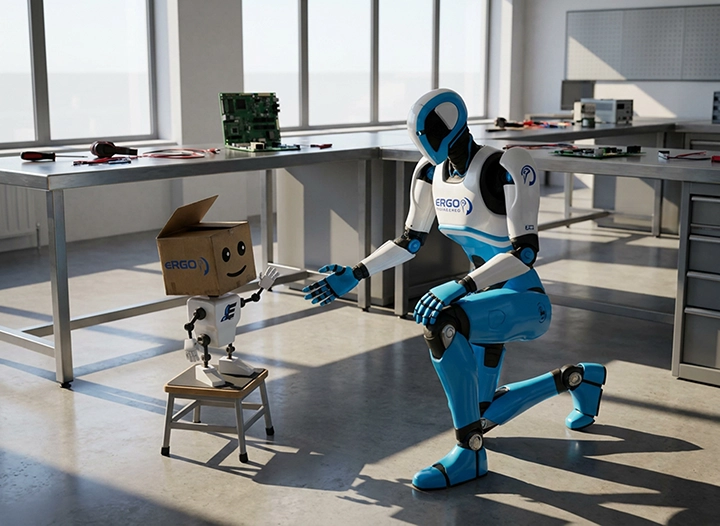
Harry came first.
I needed an avatar for my physical digital twin work in Unreal Engine - a stand-in for "the human" in Human Factors. And the moment you reach for a human figure, you're forced into a choice: male or female. I didn't want either. The human in our work is everyone, and a gendered one quietly narrows that. A droid solved it: neutral, universal, a placeholder for any body and any mind.
And it fit the work. I've spent years leading Digital Human Factors - digital twins, virtual humans, simulation - and I'm heavily invested in that space. So a droid standing in for the human wasn't just a clever dodge around the gender problem; it was a near-literal mascot for what I actually do. Harry the Droid made sense.
Then came Charlie - and a cardboard box.
Charlie grew out of my latest invention, CogniBox: a portable cognitive-load and detection-response box for measuring, in real time, how hard a brain is working. I hadn't finished the final look - all I had was a prototype, a rough rig in a literal box. So when I sketched a mascot for it, it came out with a cardboard box for a head. An honest representation of exactly where the thing was.
Around the same time I was wrestling with two questions at once. Did CogniBox need its own mascot? And, separately - Harry was a bit lonely. A single character is hard to make watchable; he needed an offsider, someone to play off in the marketing and the viral stuff.
The answer arrived, as the best ones do, sideways. I had "these aren't the droids you're looking for" rattling around my head, and from there it was a short hop to C-3PO and R2-D2 - the polished one and the scrappy one, the straight man and the chaos gremlin. That was the dynamic. And since I still didn't know how this second character should look, the cardboard box head from CogniBox just… stayed. Charlie was born.
Then the personalities took over.
I didn't plan them. They settled in on their own - and once they had, I realised they were both me.
Charlie is the prototype. A new idea launched at a million miles an hour - will it work? No idea. Build it anyway. Learn Python, learn soldering, learn computer hardware, hack it together, and - boom - it roughly works.
Every 3am session, every wild swing, and yes, every idea that crashed and burned. Plenty did. That's the Charlie tax.
Harry is the production-ready one. Sleek, finished, holding to stringent standards - the reflection of all the grind it takes to get a real product across the line.
He's the side of me that made the ErgoBytes videos: production-grade Human Factors education, shot and edited at home, alone, self-taught until it looked professional. Harry is the work that's done.
They're two states of the same thing, really. Charlie is an idea on full send - experimental, relentless, occasionally on fire. Harry is that same energy once it's been disciplined into something polished, finished and standards-compliant.
So when you see a sleek droid next to a robot with a cardboard box on his head, you're looking at the two halves of how Ergonomics Engineered actually gets made.
The prototype and the product.
The 3am idea and the thing that ships.
Both of them, me.



© 2026 Ergonomics Engineered Pty Ltd · ACN 693 121 845 · ABN 44 693 121 845